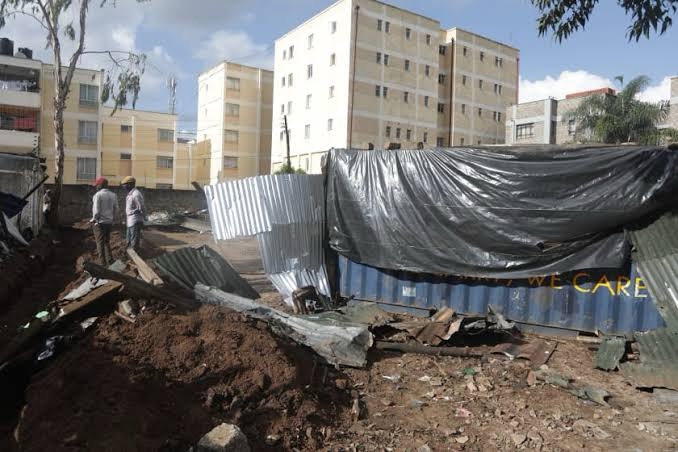
Appearing before Justice David Mwangi of The Environment and Labour Court on Monday 18th Nov, Lafey Trading Company claimed its two parcels of land worth Sh100 million were grabbed. LR No 36/VII/1076 and LR No 36/VII/1037 located in Eastleigh, Nairobi county were grabbed and certificate of titles produced in Abdi Dahir Ali and Adow Dakane Rafat names.
The firm contends it owned the two properties by virtue of an allotment letter dated August 12, 1997 and thereafter, a lease agreement made on December 28, 1999 between the company and the defunct Nairobi City Council.
The complainant was further issued with deed plan numbers 3111846 and 311846 respectively on September 3, 2010, in respect of the two parcels of land.
The firm indicated that it had been in possession of the suit properties and has made all the requisite payments to the Nairobi County government and obtained all the necessary documents thereof and was awaiting the issuance of certificates of title from the Commissioner of Lands.
Thereafter, the plaintiff fenced the suit premises with iron sheets and leased it to the Eastleigh South Jua Kali Self Help Group at a monthly rent of Sh60,000.
At all material times, the firm had enjoyed benefits from the properties until March 17, 2011 when one Abdi Dahir Ali who is now the registered owner in conjunction with Adow Dakane Rafat who was a nominated councilor in the defunct Nairobi City Council descended on the properties in the company of administration and regular police and grabbed them.
“They did it illegally and unlawfully without any court order and evicted the plaintiff’s tenants from the suit premises and destroyed their properties,” read part of the documents.
The firm argues that on November 5, 2010, the Commissioner of Lands issued titles illegally and unlawfully to Dahir in respect to the suit properties while the plaintiff was in possession of the properties.
He says that when he reported the matter to the police, they refused to assist him and instead started working in collusion with Dahir, Dakane and officials from the county government of Nairobi.
The complainant is pleading with the court to grant a permanent injunction restraining the defendants by themselves or their agents from carrying out any development, selling or transferring the properties pending the hearing and determination of the application.
Blood thirsty Somali -LandGrabbing Cartels Ways of Manipulation Against Nairobi City Hall Officials.
In recent years, the skyline of Eastleigh, a bustling neighborhood in Nairobi, has been dramatically transformed by high-rise buildings that seem to defy both gravity and the law.
These developments are often attributed to powerful Somali cartels who have gained significant influence in Nairobi, enabling them to bypass regulations and bribe county officials to build on riparian land.
This situation has become so dire that even directives from President William Ruto have failed to curb illegal construction practices, highlighting a troubling trend of corruption and lawlessness.
The Rise of Somali Cartels in Nairobi.
Somali cartels in Nairobi have become synonymous with unchecked power and influence. They have strategically infiltrated key positions within the county government, leveraging tribal affiliations to secure protection and favorable treatment.
This network of influence allows them to circumvent legal restrictions, particularly those concerning building regulations on riparian land, which is intended to protect waterways and prevent environmental degradation.
Bribery and Corruption: The Open Secret.
Bribery has become the modus operandi for these cartels.
Nairobi County officials, incentivized by substantial bribes, turn a blind eye to illegal construction. For instance, reports have emerged of officials accepting Ksh 2 million from the owners of Jannah Villas in Eastleigh’s Section 3 (Bahati Riverbank) to avoid demolishing the property, even though it stands on riparian land. This blatant disregard for the law underscores the depth of corruption permeating the system.
Defiance of Presidential Directives.
Confusion and resistance have met President William Ruto’s attempts to impose regulations on high-rise buildings in Eastleigh.
In May, Ruto announced lifting restrictions on building heights, allowing construction up to 25 or 30 storeys to accommodate the growing population.
However, during the Kenya Air Force 60th celebrations, he appeared to reverse this stance, advocating for adherence to existing height regulations to protect the airbase’s premium status.
This flip-flopping has only added to the chaos, enabling Somali cartels to exploit the situation. Developers in Eastleigh, through the Property Developers Welfare Society of Nairobi, have expressed their frustration with the conflicting directives.
They argue that such inconsistencies open the door for rogue officials to exploit them further, demanding bribes for approvals and leniency.
 KenyanHour