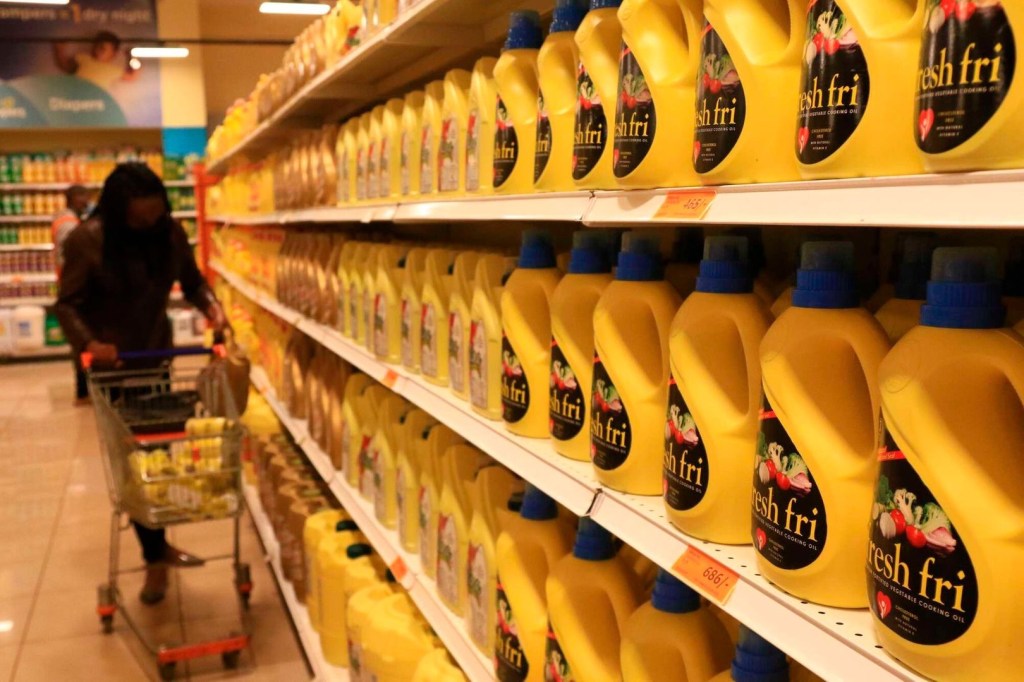
Kenya incurred a loss exceeding Ksh 6.6 billion in a government-initiated edible oil program aimed at lowering the commodity’s price. Senior officials from the Kenya National Trading Corporation (KNTC) revealed this to the Senate Committee on Trade, Industrialization, and Tourism, chaired by Seki Lenku Ole Kanar.
They admitted to spending Ksh 14.4 billion on importing the oil but were forced to sell it at a lower price, resulting in a significant financial shortfall. The companies involved in importing the oil included Multi Commerce FZC, which shipped in 1.97 million units and was paid $69.89 million (Ksh 11.18 billion); Charma Holdings Limited, which imported 499,174 jerricans and received $14.97 million (Ksh 2.39 billion); and Shehena Holdings, which brought in 13,420 units and was paid $402,600 (Ksh 64.4 million).
Peter Njoroge, the acting Managing Director of KNTC, acknowledged the loss, citing that the oil was sold at a cheaper rate due to dollar fluctuations, which fell from $160 at the time of import to $130 later. He attributed the losses to mistakes made by the former management, which cost taxpayers over Ksh 6 billion. Njoroge expressed regret, assuring the Senate that lessons had been learned and future procurement would be handled differently, including conducting transactions in Kenyan Shillings.
Purity Kimathi, KNTC’s General Manager for Finance and Business Development, informed the senators that each jerrican should have been sold for Ksh 4,813 to break even. However, they sold it for Ksh 3,700, leading to substantial losses. She pointed out additional overhead costs, such as foreign exchange losses and storage charges, that contributed to the Ksh 6.6 billion deficit.
In addition to the initial losses, it was revealed that a separate sale of uncleared jerricans at the port to Enviro Pro Kenya Limited also resulted in a Ksh 500 million loss. A total of 797,574 jerricans, originally owned by Multi Commerce, Charma Holdings, and Shehena Holdings, were sold at Ksh 3,028 per jerrican, significantly below the Ksh 3,700 price they sold to the public.
Njoroge explained that the lower selling price to Enviro Pro Kenya was due to the exemption from Value Added Tax (VAT) and the impending expiration of the oil, which is set for May next year. He emphasized the need to sell the oil before it expired to avoid further losses. The revelations sparked outrage among the Senate committee members, who accused KNTC of being run by criminals and called for accountability.
Louis Dreyfus Company (LDC) Involved in Edible Oil saga at Mombasa Port.
Imported refined palm oil is charged 35 percent duty while semi refined palm oil attracting 10 percent duty.
The product also attracts Import Declaration Fee (IDF) at the rate of 2.5 percent, Railway Development Levy of 1.5 percent and Value Added Tax (VAT) 16 percent.
Eyebrows have been raised on how imported refined edible palm oil disguised as crude palm oil entered the port of Mombasa in a bid to evade taxes.
Documents before parliament show that the product imported by Louis Dreyfus Company (LDC) was a blending of 60 percent crude palm oil with refined palm oil of 40 percent which is then declared as crude palm oil.
“They load both cargos into the same ship tanks using a 40 percent refined oil blend and 60 percent crude oil blend.
This is against the World Customs Organization guidelines as any adulterated cargo cannot be deemed as crude oil palm oil,” the documents read.
The country is estimated to have lost Sh62 billion in revenue tax for the last three years as the importation of the product largely from Malaysia and Indonesia gained entry at the Mombasa Port.
In 2022 the government lost Sh16.5 billion in revenue from the 233,000 metric tonnes that were misdeclared as crude palm oil and Sh32.54 billion in 2023 from the 387,868 metric tonnes misdeclared.
In 2024 the government has already lost Sh13.83 billion in revenue from the 163,567 metric tonnes imported so far.
Details have emerged that LDC that has no contacts on its website and the available telephone numbers could not go through is among the entities.
Most firms misdeclare refined edible palm oil to evade paying the required taxes.
“The product at the destination country requires less processing or none at all thus their customers save on processing costs,” the documents read.
The palm oil cargo imported from Malaysia and Indonesia, the world’s two leading exporters of palm oil products that accounts for 85 percent of the production, is in six types- RBD Palm Olein, RBD palm stearin, crude palm kernel oil, crude palm olein, crude palm oil and palm fatty acid distillate.
Palm oil stearin is a by-product of palm oil refining as is used in soaps manufacture and cooking fats. RBD Palm Olein is the refined palm oil, Crude palm kernel oil is by-product that is used in soap manufacturing.
Crude palm olein is palm oil that has been semi processed, which means that it has only been fractioned to separate the liquid portion from the solid portion of oil and attracts import duty at the rate of 10 percent.
Crude palm oil is unprocessed oil which requires full processing. Palm fatty acid distillate is a by-product of palm oil refining and is used to make brown soaps.
This means that were the product to be imported in crude form, the country would benefit as the by-products from the refined oil would help the soap manufacturing among others.
To promote local value addition, Indonesia and Malaysia have imposed a $70 per ton of Crude Palm Oil exports with no export duty on refined palm oil.
This means that the importers of the product save the $70 per ton duty when exporting refined palm oil from Indonesia or Malaysia and 35 percent import duty when declaring the cargo as crude palm oil in Kenya.
Because the oil is blended the local processing costs are reduced as such the companies stand to benefit more as the government losses.
 KenyanHour