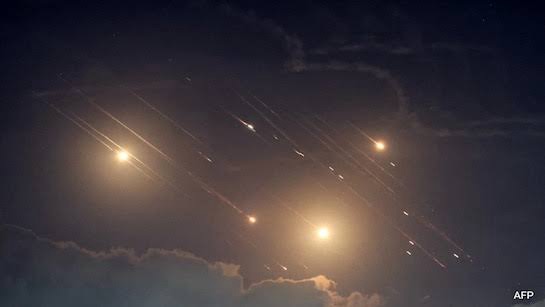
Iran launched approximately 180 missiles toward Israel, according to the Israeli military. This marks a larger attack compared to April, which involved about 110 ballistic missiles and 30 cruise missiles. Footage broadcast on Israeli TV showed missiles flying over the Tel Aviv area shortly before 19:45 local time (17:45 BST).
Military officials confirmed some hits during the attack. A spokesperson noted that Israel recorded “a few hits in the centre and other areas in the south of the country.” The Islamic Revolutionary Guard Corps (IRGC) stated that hypersonic missiles were used for the first time, claiming that 90% of projectiles hit their targets, including three Israeli military bases.
However, the Israeli military emphasized that many missiles were intercepted. Flashes over Tel Aviv suggested air defenses were at work.
BBC reporters in Jerusalem reported hearing at least two interceptions. Israeli medics reported no serious injuries, though two people were slightly wounded by shrapnel. The military confirmed similar findings.
Iran’s Islamic Revolutionary Guard Corps (IRGC) said on Tuesday that it fired missiles at Israel in response to deadly Israeli attacks against people in Gaza and Lebanon, as well as the assassinations of top IRGC, Hamas and Hezbollah leaders.
What happened?
- The exact details of the Iranian operation remain unclear, but the IRGC said in a statement that the missiles were aimed at “vital military and security targets” in Israel.
- The IRGC said later that its attack was aimed specifically at three military bases in the Tel Aviv area.
- The attack, which was accompanied by a large-scale cyberattack, also employed Iran’s new Fatah hypersonic ballistic missiles for the first time, according to Iranian state media.
- The Israeli military said it intercepted “a large number” of the 180 ballistic missiles launched by Iran, but that there were “isolated” impacts in central and southern Israel. The IRGC said that 90 percent of the projectiles fired hit their targets.
- US National Security Adviser Jake Sullivan said the American military “coordinated closely” with its Israeli counterparts to shoot down the projectiles.
- “US naval destroyers joined Israeli air defence units in firing interceptors to shoot down inbound missiles,” Sullivan told reporters at the White House.
- Sullivan said no deaths were reported in Israel: “In short, based on what we know at this point, this attack appears to have been defeated and ineffective,” he said
What was the attack in response to?
- The IRGC said Tuesday’s attack was in response to the assassination of Hassan Nasrallah, the head of Lebanese group Hezbollah, and IRGC commander Abbas Nilforoushan last week in Beirut, as well as the killing of Hamas leader Ismail Haniyeh in Tehran in July.
- Experts have warned over the past year that the Middle East was on the brink of regional war amid Israel’s war on the Gaza Strip, which has killed more than 41,000 Palestinians since October 2023.
- Lebanese group Hezbollah began firing rockets into northern Israel shortly after the Gaza war began, saying it aimed to support Palestinians in the besieged enclave.
- The Israeli military has been exchanging fire with Hezbollah across the Israel-Lebanon border since that time, displacing tens of thousands of people in both countries.
- Over the past month, the Israeli military escalated its attacks on Lebanon, striking targets in the capital Beirut and fuelling more fears of an all-out war.
How have world leaders reacted to the Iranian attack?
- Israeli Prime Minister Benjamin Netanyahu said that Iran had “made a big mistake” and “will pay for it”.
- Israel’s envoy to the United Nations, Danny Danon, said the country “will take all necessary measures to protect the citizens of Israel”: “As we have previously made clear to the international community, any enemy that attacks Israel should expect a severe response,” Danon wrote on social media.
- Iranian President Masoud Pezeshkian said in a post on X that the attack was a “decisive response” to Israel’s “aggressions”. “Let Netanyahu know that Iran does not seek war, but it stands firmly against any threat,” he wrote. “Do not enter into a conflict with Iran.”
- Mohammad Javad Zarif, the strategic adviser to Pezeshkian, said “Iran has an inherent right of self-defence against repeated Israeli armed attacks against Iranian territory and its citizens.”
- Hamas, the Palestinian group that governs Gaza, welcomed the Iranian attack as “heroic” and said it sent “a strong message to the Zionist enemy and its fascist government that will help deter and rein in their terrorism”.
- The US pledged its “ironclad” support for Israel, with President Joe Biden saying that his country was “fully, fully, fully supportive of Israel”. State Department spokesperson Matthew Miller said Washington would “stand by the people of Israel at this critical moment”.
- The Pentagon also said US Secretary of Defense Lloyd Austin and his Israeli counterpart Yoav Gallant had discussed “the severe consequences for Iran” should it launch a “direct military attack” on Israel. It did not say what those consequences would be.
- German Foreign Minister Annalena Baerbock said the country had warned Iran against “dangerous escalation”, which she said was “driving the region further to the brink of the abyss”.
- UN Secretary-General Antonio Guterres condemned “the broadening of the Middle East conflict with escalation after escalation”. In a post on X, he wrote: “This must stop. We absolutely need a ceasefire.”
What comes next?
- Israeli military spokesperson Daniel Hagari said Israel is “fully prepared to defend and retaliate” against the Iranian attack, stressing that it would be in a “timely manner”.
- Sullivan, the White House adviser, told reporters that the Biden administration “made clear that there will be consequences — severe consequences — for this attack” by Iran, and the US “will work with Israel to make that the case”.
- Iran has warned Israel against responding to its attack, threatening to launch further missiles at the country if it retaliates.
- Raed Jarrar, advocacy director at the US-based think tank DAWN, told Al Jazeera that the Middle East was now in “a full-scale regional war” that will not end without a change in American policy. “This will not stop without the United States putting its foot down and saying, ‘We will not send more weapons to Israel. We will not fund and aid Israeli crimes,’” he said.
- Omar Rahman, a fellow at the Middle East Council on Global Affairs, said “there is no question” that Israel will respond. “You’re going to get into the type of retaliatory action, back and forth, that spawns a greater war,” he told Al Jazeera.
- Rahman added that Israel “has been trying to invite this war” through its actions over the past several months. “Israel is capable of massive destruction, as we’re seeing in Lebanon. It’s capable of huge intelligence feats and waging really destruction warfare. Iran, I think, has tried to avoid that, but it’s on the path to some type of war with Israel.”
 KenyanHour