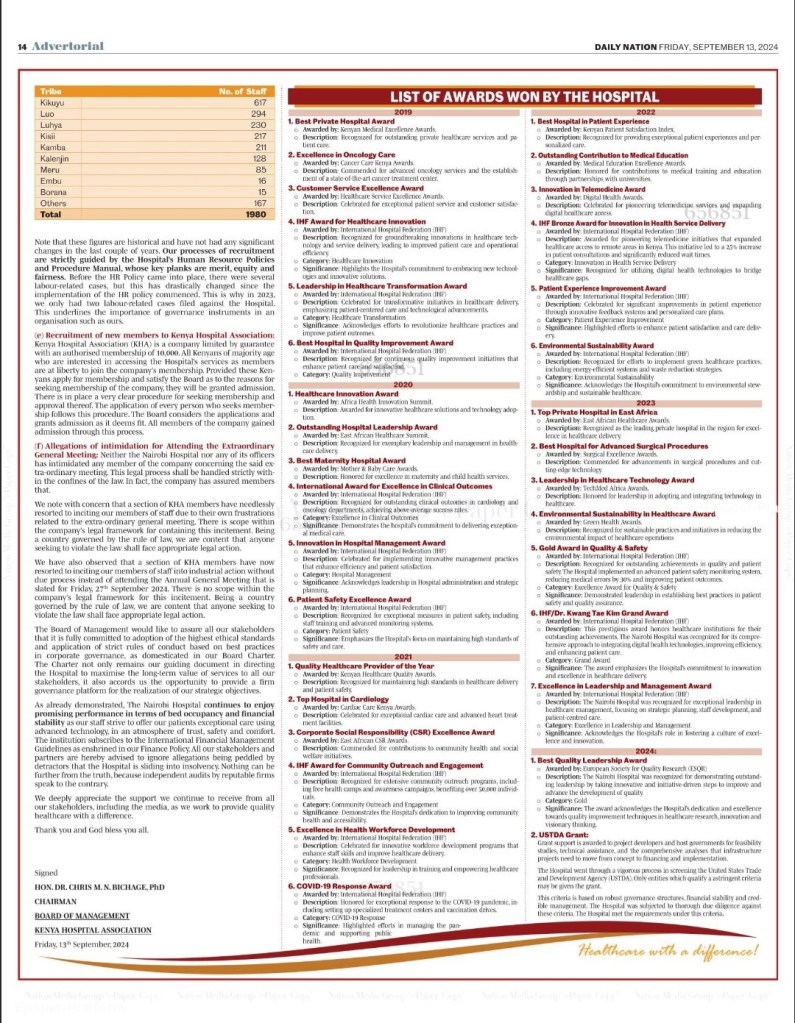
- TRIBALISM
Chairman Dr. Chris Bichage (Kisii) alliance with the CEO, James Nyamongo (Kisii), Company Secretary Gilbert Nyamweya (Kisii), Dr. Barcley Onyambu (Kisii), Dr. Fred
Kambuni (Kisii), Dr. Meshack Ong’uti (Kisii).
- Multi-million ICT Tender kickback scandal.
The tender was to supply, implement, maintain, and support a hospital management information system (HMIS) and enterprise resource planning (ERP).
This tender has been on since April 2022, when the hospital advertised in the local dailies for a consultancy for the supply, implementation, maintenance, and support of HMIS and ERP.
Board of Directors, Senior Management, Admitting Staff and the Nursing Staff offcials.
Each group wanted to own the vendor, so each procurement had been mired in gross abuse of the process.
The winning Joint Venture (JV) was awarded the contract in June 2023 at a contract sum of USD 5,643,334 (approximately KES. 960 million) for a period of five (5) years, and the contract was signed in August 2023. This has since been cancelled, and the current board chairman and the CEO’s favorite company. This led to hospital lose USD 1.6 Million to compensate the initial JV in arbitration for expenses that had already incurred.
The lawyers involved in arbitration are reported to had invoiced Nairobi Hospital KES65 Million, of which KES, 20 million had already been paid, even before the arbitration started.
So, revenues lost; Compensation for Jv lost, Lawyers paid, no tender yet procured.
The same tender that the CEO and Chairman want to procure at Sh1b, Kenyatta University Teaching and Referral Hospital procured at just Sh63million and perfectly functional.
- Mr. James Nyamongo
The Nairobi Hospital CEO, is past retirement age. Nyamongo’s contract expired in December 2023 but was renewed under mysterious circumstances against the Nairobi hospital’s human resource code of regulations.
It is alleged that Nyamongo has never gone on leave for the last three (3) years when in office, which raises many questions about the corporate governance levels of the Nairobi hospital.
Under Nyamongo, the hospital went ahead to initiate a direct tendering process for selected companies by writing to companies like Microsoft, which supplied the joint venture with the ERP in the current HMIS-ERP project, which has a running contract. This is in complete breach of the hospital’s procurement rules, where an open tender is required for any goods or services worth more than KES. 5 million.
Source revealed that Nyamongo and other board members, namely Philemon Mwaisaka (a former Provincial Administrator) and Dr.
Magdalene Muthoka (former Chief Manager, HR New KCC), received bribes from ICT Health (based in Jakarta, Indonesia). It is claimed that the CEO has used the money to build residential flats in Riat, Kisumu County. Curiously, a contractor by the name EPCO who is doing construction work for the Nairobi Hospital is the one who built the flats for Nyamongo.
The Indonesian firm favored by the cartel is not the owner of the system but is just a reseller. The system is developed and owned by an Indian company in Cheney, India. ICT Health also does not have local representation, as purported.
They gave the address of an office on Loita Street, which turned out to be a government office.
The board’s alliance with the CEO, and MAC Chairman, Dr. Fred Kambuni did put the hospital in a self-destructive trajectory. At least half of the board members have conflict of interest as is indicated by:
1. Involvement in hiring own people (Cronyism).
2. Interference with or influence of tenders and procurement to favor their companies or those they have a working relationship with. This includes creating unnecessary court cases and procuring lawyers to defend obvious wrongs.
3. Having own companies and relatives or friends who must do business in the hospital and with the hospital.
4. Influencing how much is paid out for what to who. This includes contracts and salaries, and also irregular pensions.
5. Influencing the membership for purposes of soliciting votes to stay in the board. Recent reports indicate that two members alone recruited about 50 and 100 new KHA members respectively. The articles of association do not allow any one member to recruit more than 5 new members at a time.
6. Influencing the virtual voting system to favor them and their preferred and chosen board members. The virtual voting system was introduced temporarily during the Covid and has been widely abused at the KHA elections in the last four to five years.
The Rift between ASA, MAC, BOARD, CEO, and CHAIRMAN.
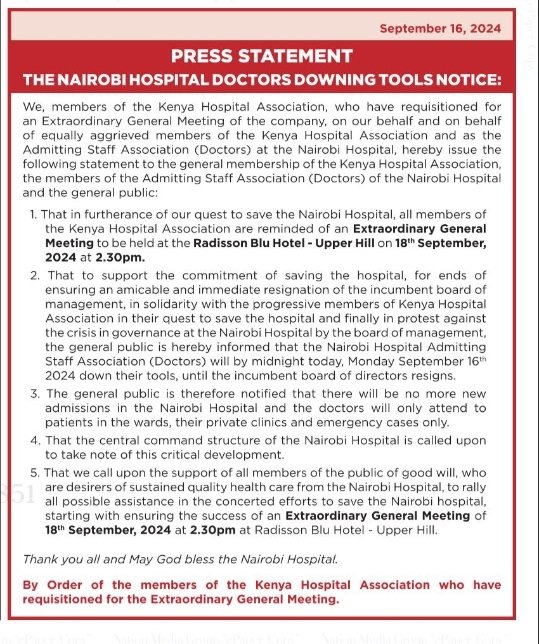
The Admitting Staff Association (ASA) on one side and The Medical Advisory Committee, previously chaired by Dr. Fred , The CEO, Mr. James Nyamongo and the board chairman, Mr. Chris Bichage on the opposite side.
The Admitting Staff Association(ASA) is comprised of the doctors practicing at The Nairobi Hospital, and are represented at the Board of Management, by the Chairman and Vice Chairman of the MAC. The MAC is made up of doctors who chair the various departments involved in the care of patients. The MAC is therefore, is the voice of the doctors and nurses, providing direction to the board and hospital management in achieving the highest standards of medical care.
MAC advice comes from ASA, and will be implemented by the board and the hospital administration as much as resources allow. This is given that the ASA and the nurses are the engine of the hospital and generate approximately 99% of the hospital revenue.
When MAC does not convey ASA needs, then the quality of health care suffers. The Vice Chairperson of MAC resigned recently in protest, because she realized the board wasn’t taking the MAC advice, and therefore ASA issues were not on the table. She received morbid threats for exposing the failures in MAC.
The previous MAC Chairman, Dr. Fred Kambuni, who was elected about six to seven months ago, had gone into an unholy alliance with the Board Chairman, Dr. Chris Bichage and the CEO, Mr.
James Nyamongo to subvert ASA issue and take over the role of MAC for their own personal interests. ASA members have accused MAC of not representing the doctors’ interests. The ASA, therefore called for a Special General Meeting and recalled the MAC on the 25th April 2024
The CEO then on 29th April suspended and sued the ASA members who flagged integrity issues in the hospital for alleged sabotage. It is important to note that a CEO has no powers to suspend a doctor. There are mechanisms for such action, and the CEO only implements the board direction. That. recommendation to discipline a doctor is taken by standards and ethics committee to the board after a hearing. All this did not happen.
Who Owns Nairobi Hospital?
Kenya Hospital Association (KHA), now loosely owns medical facility. Members of this association are the shareholders responsible for appointing and removing directors and other senior managers in charge of day to day operations of the facility.
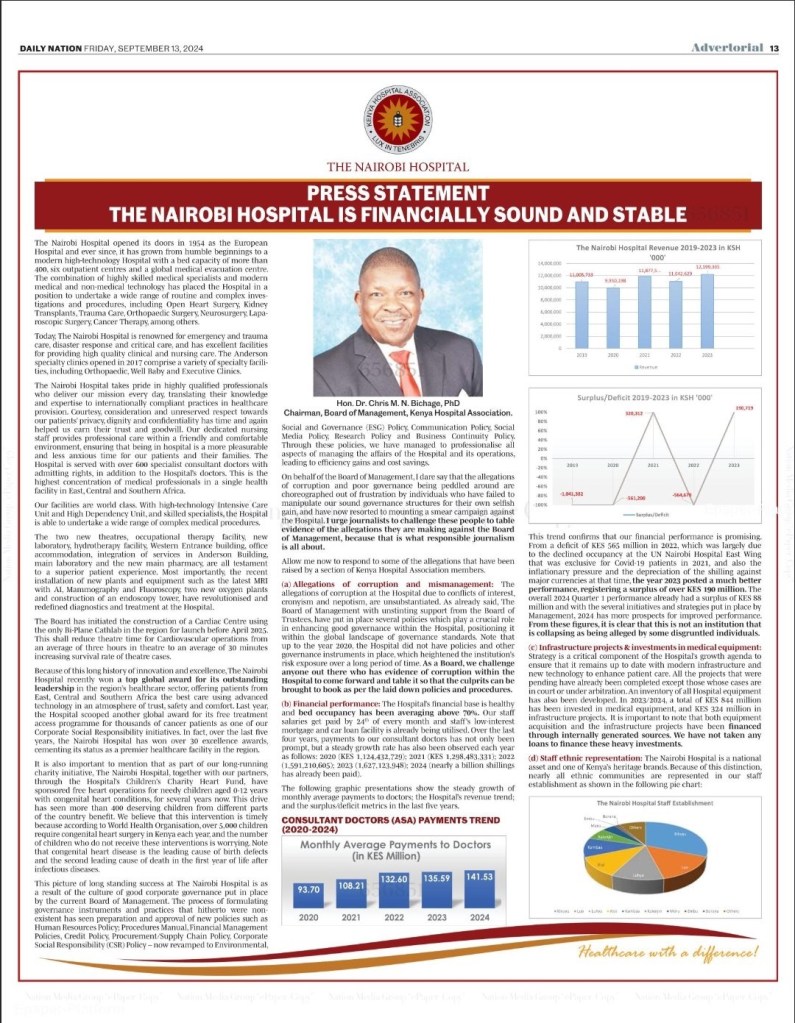
However, Corruption in the Nairobi Hospital has taken the forms of tribalism, embezzlement of hospital funds, demands on vendors of acutely high mark-ups, rampant bribery and blatant abuse of office. Though clearly stated by the hospital’s articles of association that it is unethical for Board members to conduct business with the hospital due to the attendant conflict of interest generated, procurement corruption continues on an upward trajectory in the hospital. Individuals continue to bypass existing tender regulations, securing tenders instead for self, relatives and friends/cartels. Cartels collude in price-fixing and other behavior that prevent fair competition.
With the poor governance The Nairobi Hospital is currently experiencing, there is virtually no accountability since the common purchase processes of budgeting, accounting and auditing continue to be abused. Large amounts of money are channeled to fraudulent deals. Serious concerns include not having employed a competent Finance Manager for more than a year, and also having questionable lists/regulation of signatories privy to the hospital’s bank accounts.
All this has exposed The Nairobi Hospital’s financial management to unethical activities and pilferage, with serious consequences to the cash reserves required for running the core functions of the hospital.
Infrastructure and Facility Management
Plumbing works are being handled by a firm known as Rabiya Plumbing, with subsequent multiple corrections at the cost of the hospital.
The plumbing firm is owned by an MCA from Embakasi,who happens to be the son-in-law of the Board vice chair, Philemon Mwaisaka. He also recently led a Nairobi Hospital CSR project in Embakasi, and is often in the hospital serving as a power broker, negotiating contracts and employment for persons known to him. He is probably also the DJ at the Nairobi Hospital Gym.
An alliance with a law firm based in Westlands and headed by a flashy advocate from Western Kenya who specializes in construction disputes and serves as dean at a nascent school of law has become the hallmark of wantontheft from the hospital coffers. This advocate has been retained for matters as mundane as:
1. Discharge of hospital titles from creditors at a cost of KSh. 20 million
2. Appearing online in court four times on matters of delayed KHA Board elections in 2022 at KSh. 18 million
3. Suing hospital Admitting Staff at KSh. 10 million
4. Arbitration on the cancelled botched ICT contract at KSh. 65 million
The construction disputes and arbitration at KSh. 180 million, among others.
In collaboration with the said advocate, these cases are farmed out by the Board chair and the CEO without full board approval and the deal signed. The Board is then merely notified and, to avoid pecuniary embarrassment plus further legal challenges, there is the assumption that tacit approval pending regularization has occurred. Thesehave exposed the hospital to further potential loses in terms of legal payouts of a sum close to KSh. 250 million.
Meanwhile, it is of note that the advocate referred to, after realizing the inherent weakness of the CEO’s suit against the admitting doctors rushed to court on the eve of the hearing of the case, blocking this in the pretext of requesting the court to allow out-of-court negotiationsover the next three months between the aggrieved doctors and the CEO to settle the matter.
The Nairobi Hospital Suppliers Closing Accounts:
By early April, the hospital owed creditors of drugs, equipment and food a sum of 1.2 billion, and was struggling to meet the OPEX budget line. Liquidation of various fixed deposits has had minimal impact on debt management simply because the Board chair and CEO seem bent on extravagant expenditure on incessant legal fees and purchasing non-clinical items.
As a consequence, many pharmaceutical drugs suppliers, equipment suppliers and surgical implant suppliers are advising their medical partners (doctors) to utilize other institutions that have a better paying record. This will have damaging effects on the hospitals image, and it may take a long time to win back the trust of the hospital’s long-time suppliers.
According to exasperated suppliers, some of the pro-Bichage team staff in the Procurement docket frustrate them by acting as ‘demi-GODS” like Davis and making outrageous demands to
‘facilitate’ supply chain processes which they are already duty-bound to follow.
More to follow..
 KenyanHour